The Sand Bridge Chronicles

Getting There, One Handful of Sand at a Time

Signature of Jesus Found in Ecuador

August27

Ecuadorians called them savages, but they are the Huarani people. A primitive tribe, they lived in the shadows of the jungle in Ecuador, launching savage attacks against one another, attacks that went on so long, no one remembered what rift had begun them. They were well acquainted with death but not with the outside world until, in 1956, five American missionaries went missing after making contact with them. Jim Elliot, Nate Saint, Roger Youderian, Ed McCully, and Peter Fleming packed a small plane with gifts and began making inroads with the tribe in hopes of reaching them with the Gospel. After just a few days of contact, the Huaorani killed the five men. A handwritten journal chronicling the contact was left behind, as were five young widows and their children. News of the deaths spread worldwide.

The story is unusually sticky – not complicated sticky – but hard-to-forget sticky. Though newspapers would focus on the martyrdom of five men, the best of part of the story happened two generations later. After Nate Saint’s aunt and Jim Elliot’s widow returned to the Huarani to complete the mission of the young evangelists, an unbreakable interconnection between the murderers and the martyred men was forged and continues today. The entire tribe trusted in Jesus and gave up violence. The man who murdered Nate Saint has become a surrogate grandfather to Nate’s grandson who has lived with and loved this warrior, now gentle because of the Spirit of Christ. The grandchild who never knew his grandfather knows intimately the man whose hands murdered him.

It is almost unfathomable on every level. It is hard to comprehend how such a violent people can turn gentle. It’s even harder to comprehend a new widow returning with the Gospel to men who savagely murdered her husband. It’s hard to believe that a single woman, aunt to one of the murdered men, would return and spend the rest of her life with the Huarani and be buried among them after her death. And it’s an even larger stretch of the imagination to see documented on video (Beyond the Gates of Splendor) the playful grandfather-to-grandson relationship between the killer-turned-saint and the victim’s offspring. Unbelievable, that is, unless you know much about Jesus. This kind of impossible is the unmistakable signature of Jesus. And nothing and no one on this earth has anything like it.

No anti-depressant or anti-psychotic can bring change like Jesus. He makes brothers of enemies. He makes violent men peaceful. He enables victims of great atrocities to forgive their perpetrators. Five men gave their lives to bring the Gospel to people who had never heard it because they followed Jesus whose pattern was the same. Their death opened the door for Jesus to create brothers of enemies.

Which is more amazing? Men who would lay down their lives or men and women who would forgive? I tend to think that to forgive comes harder for humanity than even death. Would not some rather die than forgive (and do so every day)? Yet forgiveness is the most radical and central characteristic of Gospel. To forgive is to suffer, not unlike two women suffered to return to men who murdered their loved ones and led them to Christ. From the death of five and the forgiveness of many, Jesus created a new people and an unlikely kinship between an old murderer and a boy. Beauty from ashes. That is the unmistakable signature of Jesus.

A Mosque at 9-11

August26

No need to read an article. The headlines are clear. A hot dispute continues: is building a Muslim mosque near the site of the 9-11 bombings of the Word Trade Centers right or wrong?

Because the arguments center on the question of right and wrong, I can’t help but remember a statement made about that question many years ago. In China in 1952 a man was imprisoned for his Christian faith. He spent 20 years in prison before his death in 1972. He was Watchman Nee and, “Right or wrong,” he said, “is the principle of the Gentiles and tax collectors. My life is to be governed by the principle of the Cross…” He then went on to tell this story.

A [Christian] in South China had a rice field in the middle of the hill. In time of drought he used a waterwheel, worked by a treadmill, to lift water from the irrigation stream into his field. His neighbor had two fields below his, and, one night, made a breach in the dividing bank and drained off all his water. When the brother repaired the breach and pumped in more water his neighbor did the same thing again, and this was repeated three or four times. So he consulted his brethren. “I have tried to be patient and not to retaliate,” he said, “but is it right?” After they had prayed together about it, one of them replied, “If we only try to do the right thing, surely we are very poor Christians. We have to do something more than what is right.” The brother was much impressed. Next morning he pumped water for the two fields below, and in the afternoon pumped water for his own field. His neighbor was so amazed at his action that he began to inquire the reason, and in course of time he, too, became a Christian.

A man acquainted with suffering for his faith, Nee encouraged his fellow Christians not to stand on their rights. To Nee, the principle that should govern us is not the question of right or wrong so much as whether or not we are conforming to Christ. Nee says, “We have nothing to stand for, nothing to ask or demand. We have only to give. When the Lord Jesus died on the Cross, he did not do so to defend our ‘rights;’ it was grace that took him there.”

I don’t know if it’s right or wrong to build a mosque so close to the 9-11 site. But I think I know what Jesus asks his followers to be about:

You have heard that it was said, “Eye for eye, and tooth for tooth.” But I tell you, do not resist an evil person. If someone strikes you on the right cheek, turn to him the other also. And if someone wants to sue you and take your tunic, let him have your cloak as well. If someone forces you to go one mile, go with him two miles. Give to the one who asks you, and do not turn away from the one who wants to borrow from you. You have heard that it was said, “Love your neighbor and hate your enemy.” But I tell you: Love your enemies and pray for those who persecute you, that you may be sons of your Father in heaven. He causes his sun to rise on the evil and the good, and sends rain on the righteous and the unrighteous. If you love those who love you, what reward will you get? Are not even the tax collectors doing that? And if you greet only your brothers, what are you doing more than others? Do not even pagans do that? Be perfect, therefore, as your heavenly Father is perfect.

Right or wrong, the question provides an opportunity for the followers of Jesus to ask him, “How can I love my enemies?”

Dying Well, Thank You Dr. Hawthorne

August5

My Greek professor died yesterday morning. His last great test on this earth is over, and though a painful and swiftly progressing cancer made for intense suffering in his final days, the battle for him is won. He has passed on to glory.

I knew him for such a short time, but as beloved professors can, he marked my scant four years in college with sweet memories. He used to show up to class in cowboy boots. His wife would have us all over for meals. He had a heart for students who struggled with Greek, an uncanny patience with the lot of us. In the upper level exegesis courses, he used to give us copious notes on the text, all handwritten (I still have them). He wrote books and edited commentaries. He was highly respected and admired both by his colleagues and his students. And he was also amazingly approachable and personable.

I remember sitting in Beginning Greek while he was lecturing one day. Two of my friends were behind me, and beside me was an extremely quiet and shy young man who hadn’t made eye contact with me the whole semester. I like to lean on one elbow. I like sitting criss-cross applesauce. I like sitting on one foot. So in the middle of this lecture, with two pre-seminarians behind me and a mysteriously shy 20-year-old to my right, I picked up my right foot to– naturally– fold it under my seat. What I hadn’t counted on, however, was that the chair had an attached desk, one of those desktop things attached to the right of chairs commonly found in college lecture halls. Apparently, when a desk is attached to just one side of a chair, that chair is naturally off balance. So when I lifted my right foot to fold it under me, and when all of my weight combined with the rightward leaning of the chair, the chair and I in unison lifted off the floor and began a slow-motion rightward leaning into the lap of the shy boy. With my feet suddenly airborne and my chair tilted just enough, there was no hold to stop my fall nor had I any way of tipping myself back level. So with my feet dangling in the air, I waited rather helplessly in the shy boy’s lap until he, blushing, pushed my chair back upright. Paul and Dan, the friends behind me, were practically crying in stifled laughter. My professor glanced at me mid-lecture, trying to figure out what in the world had happened, smiled, then gracefully resumed his lecture (the shy boy maintained a no-eye contact strike for the rest of the year).

My professor smiled a lot like he did that day my chair tipped over. He was often smiling, and he seemed to take genuine pleasure in the Word of God and his students getting excited about it, especially when their excitement came from a Greek word or phrasing. He was the kind of man who lived well.

His family did something wonderfully generous once the decision was made to start Hospice care at home for him. They set up a Caring Bridge website to journal for others what was happening as they cared for Dr. Hawthorne in his last days. Hundreds of us were able to write in their guest book and share our memories and prayers for Dr. Hawthorne and his family. News of his passing yesterday was bittersweet. I’m sad that he is gone, but I don’t think I’ve ever been so confident of anyone’s dying well as I am of his. He was a man who both lived and died well. In those final days, he was looking ahead to the joy set before him, enduring his cross.

I hope to die so well. Thank you, Dr. Hawthorne. I will be so happy to see your shining face on the other side.

Waking from Slumber

July11

The trumpet blast sustained for a time as the herald cried out, “Awake, you who sleep. Arise from the dead!” I did, roused slowly by the trumpet’s sharp tenor as it finally broke the spell of sleep. I came to, rubbing the crusts of sleep from my eyes only to find in my stupor that I sat amidst a terrible battlefield. The slain were to my right and my left. Some mounted on beasts were horribly wounded but still slicing the air with their weapons. Some wielded long, shimmering swords. Others covered their heads with only bare hands, trying to absorb the blows of an enemy I was blearily trying to make out through the fog of my own daze. I was so astonished at the idea of a battle, so stunned at the thought of an actual enemy that for a long time I could not move. Until the horrific stare of its eyes turned towards me.

I began clawing desperately at the ground for anything I could find to defend myself. And I opened my mouth to cry out. It was weak and scratchy from sleep, but I must have uttered a sound of some kind as the herald himself appeared as though through smoke. He positioned his mount between me and the attack and fixed somber and discomfiting eyes on me. Those eyes, though grave, were also strangely musical, as though in looking into them a lyrical ballad was ushering forth, reaching into my depths and speaking. I immediately turned towards the ground where armor and weapons lay haphazard in a heap. These were obviously unkempt and quite obviously mine, though their unfamiliarity and poor condition was a shock. Rust had crept over much of the iron parts. But I knew to pick them up, and I knew their disrepair was due to me.

Relief at the herald’s salvation mingled with shame at the condition of my gear. How could I have slept so long? Surely in the eyes of this herald was a music that had been playing all along because it was so familiar, so wildly reminiscent. In his eyes, I saw that I had let myself fall asleep, exposed myself to a great evil. Certainly from youth I had known better than that.

But all had to be put behind me now. The battle was upon us, and it was time to engage. The trumpet was still sounding, and more and more lifeless bodies were rousing from their drunken stupor. Without sound, the herald had come about and was leading a squadron into the enemy’s dark flanks. It was time to follow, awake.

“Awake, you who sleep, arise from the dead, and Christ will give you light. See then that you walk circumspectly, not as fools but as wise, redeeming the time, because the days are evil … Be strong in the Lord and in the power of his might. Put on the whole armor of God that you may be able to stand against the wiles of the devil. For we do not wrestle against flesh and blood, but against principalities, against powers, against the rulers of the darkness of this age, against spiritual hosts of wickedness in the heavenly places. Therefore, take up the whole armor of God … praying always with all prayer and supplication in the Spirit, being watchful to this end with all perseverance and supplication for all the saints…”

-Ephesians 5:14-16, 6:10-13a, 18

Whispers through the Veil

May10

I have met many Christians who speak confidently about God’s conversations with them. They are likely to say things like, “God told me to go down one more aisle; I did, and lo and behold, there was a parking place! Isn’t that just like God,” they ask. I have never had God tell me that, and I have trouble relating to it. I have wondered if they are really hearing God as well as why I don’t seem to hear such things.

Most of my Christian experience is with a veiled God. I can talk to him, but if he talks to me it is not as he did with Adam in the garden. His voice is a silent one, heard in the timbre of my own voice as I read the written words of scripture. On those special occasions when I am praying and unique words spring to my consciousness, I sometimes think it is God, but I don’t always know with clarity those words were his and not just my own imaginings.

Then there are days when I do know, when the words that form in the quiet of my being are unmistakably his and uncannily personal. Though they’ve never pointed me to a parking place, when these moments happen, the words are as intimate as a whisper. They penetrate the veil, and for a moment, the light of God’s face touches mine and reveals his heart to me in a way I cannot deny.

The sun was still low in the morning sky, but the air was already warming. It would be a hot and humid day. The man in line before me called back over his shoulder, “I’m always glad to be flying out before the heat of the day.” We were waiting in queue on the tarmac to board a plane home. I was flying alone because there weren’t enough seats for both my husband and me to travel together on our stand-by tickets. I’d waved good-bye as he waited at the gate having received the final word that everyone had shown up to fly that morning; there’d be no more room for additional passengers. He’d try for the next flight.

Even though a short line, it was slow moving, and I was praying silently. I had developed a fear of flying. I used to fly far more often, usually on business; but with four young children at home now, I flew quite rarely. A friend from our early days of marriage lost both of his parents in a plane crash, and I couldn’t seem to get on a plane without remembering that. No one who flew with me would know that I have a fear of flying; I manifest no outward signs. I can chat with other folks in line and function fine, but I pray a lot and agonize on the inside. So as our line ambled turtle-like towards the plane, my inner dialog was intense. I wondered if my separate flight from my husband was God’s coordination to spare one of us so that our children would not be parentless at the end of the day. I asked God to forgive me for being fearful and so morbidly creative in my thoughts. I prayed for courage. I reminded myself that I could fly without fear because God’s will was ultimately for my good, regardless of the outcome of this day. If this were the day of my death, I didn’t want to fear it; but I was still feeling the inner tremble of fear and worrying about my motherless children.

When it was my turn to board, the first officer smiled and said, “Good morning,” his gold-rimmed sunglasses reflecting the sun not too unlike his teeth which were noticeably white. He looked like he could barely be older than 18. I answered his greeting and climbed the steps onto the plane. Passing the cockpit, I saw that the pilot didn’t look any older than the first officer. On board, the air was hot and still. The plane was small, just one seat on each side of the narrow aisle. It probably carried no more than 18 passengers. I sat down at the exit window, arranging my handbag on my lap and fastening my seat belt. The first officer was closing the door. He walked deliberately down the aisle and stopped at my seat. I was pretty sure he was asking if I was able to perform the duties required of sitting by an exit, but he spoke in such a fast, rote manner I wasn’t altogether certain. He pointed at the window as if to show me the emergency hatch and made a pushing motion with his hands towards the seat in front of me to indicate that it had to be pushed forward first. I smiled and nodded my head; yes, I could perform exit duties. I did wonder, though, how I’d push the seat in front of me forward with a passenger in it. How would she know that she’d need to get out of her seat in order for me to open the window for our escape? I could imagine our frenzied dialog over the seat as the plane plummeted downward. Then I reminded myself that if the plane were going down, the emergency window wouldn’t be much help anyway. I started to pray again.

I pulled my Bible out of my bag and opened it to the Psalms. It happened to open halfway through the 119th psalm, and so I began reading there. The psalmist wrote of his delight in the statutes of the Lord. I was captivated by the fervor of the language. I read to the end of the chapter before setting the Bible down to rest on my handbag. The engines revved as the plane began its taxi, readying for the signal that would authorize takeoff. The signal must have come quickly as we were soon accelerating down the runway, the turbo-prop engines straining loudly, the tat-tat of the wheels speeding over the seams of the concrete until at last the plane nosed up and off the runway altogether.

I was watching the familiar shrink into something tiny as the plane climbed higher and the city below diminished into something that could have been a model town in an N-gauge train display. I had no peace about the outcome of this flight, and I had had peace on past flights. At some point on those flights, while praying, I would sense something of a reassurance that the plane would land safely again. I began to read the next psalm and then the next, taking breaks to pray a little and also to quiet my thoughts. I knew that fear was playing with me, and I was letting it. It didn’t seem as though any willpower on my part was enough on its own to quiet me. I felt silly for being prey to fear, but there it dangled me as though I were, like the city below, in miniature. It was as though I hung, suspended from a string in the hands of a giant named Fear, and I was batting my tiny fists at the air but accomplishing nothing other than to tire myself out. If Fear could smile condescendingly at the innocuous toy dangling from its fingers, it was most certainly smirking now.

And that’s when the plane banked. The wing dipped, and the horizon tipped askew. The sudden motion was like someone throwing open a blind on a dark room. The sun, that low-but-ever-climbing morning sun, flashed through the window so brightly that I could barely see, and I had to cup my right hand over my eyes to shade them. So there I sat at the window marked with red e-x-i-t letters, my right hand shading my eyes from the sun so I could read, and I read:

“The Lord watches over you –
The Lord is your shade at your right hand;”
The sun will not harm you by day,
nor the moon by night.”

A shiver shot down my spine. I exhaled with a graceless grunt as though I were being wakened unexpectedly. I felt the need to look around at the passengers nearby like one might if he had heard a strange noise and needed confirmation that he wasn’t the only one who heard it, but this was no strange noise. It was a flutter inside. Attentive, I continued to read:

“The Lord will keep you from real harm –
He will watch over your life;
The Lord will watch over your coming and going
both now and forever more.”

There was the whisper through the veil, the personal whisper of a God who will speak intimately not because he has to but because he chooses to. A quiet tear wet the inside of my cheek. I marveled at a God who had no obligation to speak into my moment but chose to speak lovingly to my greatest fears and quiet them. Through ancient and mysteriously powerful words penned in another age, he gave me assurance. If he hadn’t gotten my attention with the words, “shade at your right hand,” I might have found some universal consolation in the words to follow; but I would not have heard them as intimately as I did. I would not have seen them for the personal whisper they were, the kind that comes only from someone who really loves you and wants you to know it, someone who knows what your right hand is doing at any given moment.

I prayed, “Thank you. Thank you, thank you,” and with my finger mopped the inside of my cheek. The whisper through the veil is still sweet to my taste.

“There is no fear in love. But perfect love drives out fear…”

-  I John 4:18a

Uprooting Winter

March11

Rain foiled my intentions today to uproot winter from the yard. I’ve been avoiding the sad, forsaken planters and flower beds, once beautiful adornments now turned brown and brittle from the one-two punch of winter’s cold and my neglect. With the coming of warmer weather this past week, the kids have reclaimed the back yard, and dozens of red plastic cups litter the scene with secret botany experiments, “soups” I was told. Here and there between cups, the 4 and 5-year-old children proudly marked thirty-some of the dog’s land mines with bricks leftover from an addition project, an idea they thought quite imaginative. It’s as though, instead of spring, we are sprouting bricks. A collapsing, old Cozy Coupe is parked in front of the screened door, and “Nella” the scooter is parked haphazardly close so that you can’t open the door more than a few inches without hitting it. A bucket sits on the step with yet another soup that will spill its guts just as soon as someone decides to open the door and exit. Along the back fence, someone ran the Green Gator into the Cast Irons where it has idly collected leaves and pollen and more soups. I wonder how many mosquito larvae may be mixed in with this one, patiently waiting for the first day warm enough to hatch?

Now amidst this disheveled yard, the chaos of which makes my heart sink if I’m honest, is the most gorgeous Camellia tree you can imagine. It stands 14 feet tall, busting gut with the cheerful fuchsia blooms of spring, blooms so plentiful the foliage fades into the background. This tree was probably planted along with the house, back in the late 1930s, and its crown is 16 feet in diameter, an amazing size for an ornamental tree. Even in the wake of winter’s cold indifference, this tree is a sign of life, a monument to spring’s stirrings. Even in the ugly plastic containers that clutter my view of a bountiful creation, life is brewing and cells are replicating in their biological soups.

I am reminded that in the midst of my soul’s winter stands a remarkably vibrant tree of life. It holds out hope that beauty and order are near. Life is stirring. Wake up, sleepy one. Wake and cast off winter’s heavy garments for the Lord “wakens me morning by morning, wakens my ear to listen like one being taught (Isaiah 50:4).” Though “I lie down and sleep; I wake again, because the LORD sustains me (Psalm 34:6).” Spring is coming.

On each side of the river stood the tree of life, bearing twelve crops of fruit, yielding its fruit every month. And the leaves of the tree are for the healing of the nations…Blessed are those who wash their robes, that they may have the right to the tree of life and may go through the gates into the city (Revelation 22:2, 14).

The Lost Sin

February13

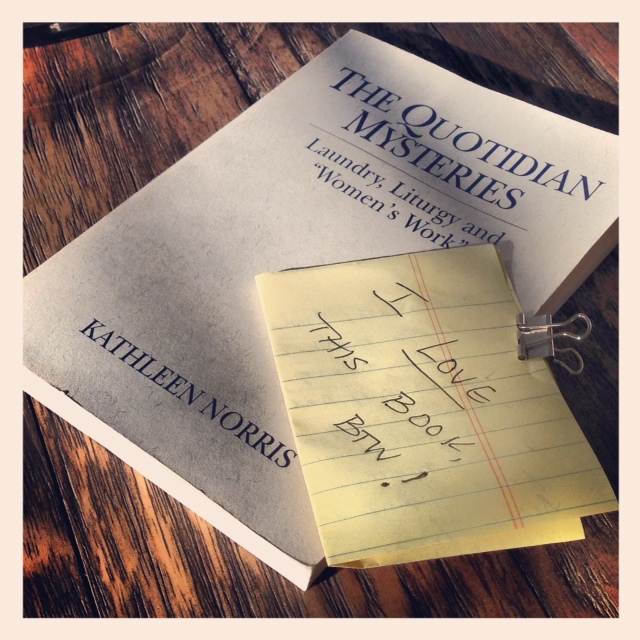
I read a book I can’t finish. I’ve read every page, but I’m not done with it. It smelled of something monumental, sent flutters into the pit of my stomach whispering, “Listen. See. Hear.” The book wasn’t about the next self-help step. It didn’t unlock a passage of scripture that provides a prayer you can pray to find ultimate joy or prosperity. Instead it exposed a sin, an ancient sin that Dante and Chaucer wrote about, Luther mentioned, the desert fathers feared and that monks in monasteries around the world seem to know intimately. One of the famous seven deadly sins, it seems to have lost popularity over the ages; and the reason I’m not done with the book is because I’m afflicted with it. The sin is acedia, and what the author of Acedia and Me, Kathleen Norris, wrote about it, cut deeply. I knew I’d been had by something.

Sin is something we like to hide, even from ourselves, but much like our bodies give us signals when something inside isn’t going right, our lives show symptoms of hidden sin. When I met the word acedia, I knew I was onto something; I had a name for my disease. As much as I hate to read about sin and hate the process of exposing my sin, I know that naming it is one sure step to getting help.

Acedia is described as spiritual weariness. It is sometimes called torpor, sometimes sloth, sometimes busyness, often apathy and often melancholy. Psychologists might diagnose it as chronic dissatisfaction. A pastor might call it discouragement or burn-out. The Catholic Church defines it as “a form of depression due to lax ascetical practice, decreasing vigilance, carelessness of heart.” The monastic fathers knew it was deadly for community because it was known to render a monk passionless and separated from his community. Often it was the cause of a monk’s leaving monastic life altogether.

The last twelve years have been prolific for me. I’ve borne four children. I’ve disinfected, taught, cautioned and laundered many times over. I’ve been  part of planting an exciting new church, grown in community with people who shared a common vision, taught the Bible to young children, cooked meals for teenage boys learning about Jesus through an inner city drum line, coordinated a women’s ministry, led Bible studies, organized retreats, facilitated meals for families with new babies, hosted community groups in my home, supported my husband in his ministry as an elder in our church, served on committees, met with women going through painful circumstances and managed a household with four children. Many of those things I did all at one time. I don’t share these things to impress anyone. I share them to show the contrast between then and now. Acedia was lurking around the corner.

One day I woke up and felt tired, very tired. Ridiculously tired. I was driving to pick up my then eleven-year-old from school and realized I was taking turns with my hands holding the steering wheel. I’d hold the wheel with one hand. Then I’d switch to the other. I’d switch feet on the gas pedal too, so that I could take turns resting my feet. I started waking up unable to unclench my right fist for the first hour of the day. I was experiencing  pain and tingling in my fingers. Checking out at the dentist with my daughter, I started to stumble over my words. I wasn’t able to pronounce a simple word, and past experience told me I was at the beginning of a migraine. I’d never struggled with migraines except during pregnancy. I wasn’t pregnant now. I was just very tired.

Our church started to shrink. Most of the families we would have considered critical to our vision left. Much of the “prolific” past few years began to feel like a meaningless vapor. Emotionally I began to protect myself from the pain of attrition. My husband’s more-than-full schedule was taking its toll on him and our family. We began to pull back and protect our family. We reduced our activities to a small few. We pulled back from community. We went into survival mode. I got more sleep, but I was still tired. In addition to the fatigue was now a growing loss of feeling. Apathy had started to replace what had once been hopeful excitement and passion. Acedia had more than well established itself by now.

The tediousness of my life began to swell in my imagination. I woke to a grim awareness that everything I would do would need to be done all over again the next day. What I would accomplish one day would be undone by sunrise. Acedia was opining that what I did wasn’t of any worth, that any aspirations I had weren’t worth the effort. It nagged me to get tasks over with quickly as tomorrow I’d have them all to do over again. I began to live a tedious, monotonous life. One day I will write about tedium’s gifts, but acedia makes us think only of the insurmountable burden of the day. It blinds us to God’s gifts and presence in the ritual of, yes, monotony. Energy dwindles to sighs. A prolific life turns inward. Not only does the child of God grow weary of the monotony of each day, but he grows tired of himself and tired of the needs of those around him. Acedia grows like a canker. Norris says:

Not only does it make us unable to care, it takes away our ability to feel bad about that. If we can no longer weep, or desire, or feel pain and grief, well, that’s all right; we’ll settle for that, we’ll get by.

Whether there is a wily devil lurking out there or we have merely bedeviled ourselves with delusions concerning the true nature of sloth, I am intrigued that over the course of the last sixteen hundred years we managed to lose the word acedia. Maybe that’s one reason why, as we languish from spiritual drought, we are often unaware of what ails us.

I am convinced that acedia is at its best when the child of God despairs, for spiritual apathy is hence born and he, in the words of Dorothy Sayers, “remains alive because there is nothing for which [he] will die.” Cesare Pavese in his memoir The Business of Living: Diary, 1935-1950, laments, “Oh! The power of indifference! That is what has enabled stones to endure, unchanged, for millions of years.”

I could give lots of reasons why I landed in the kingdom of acedia, but now that I have a name for it, my primary interest is in getting out. I have no desire to be unchangeable. I care not to stand at judgment before my Creator and be likened dull or hard like the stony heart of an Egyptian pharaoh. Unfortunately, knowing how you got into a place is important to knowing how to get out. So I’m in the process of retracing my steps. I’m re-reading the book and making notes. The monks had a cure for acedia. Praying the Lord’s Prayer was one of them. Certain psalms were prayed. Spiritual mentors encouraged monks to remain in community and to push through their daily disciplines of prayer.

Meanwhile the tedium of my job as a “stay-at-home mom” makes me prone to acedia. Though I know there is worth in what I have chosen to do, I am also constantly aware of the sacrifice I have made to do what I do. As much as I love my children, I miss the fulfillment I found in a different form of work. I find myself prone to wandering in my own life. When the day is broken into tiny snatches of time, it is easy to throw up hands and admit that nothing productive can come of thirty minutes here and thirty there. It is easy to grow weary of the same monotonous tasks done over and over again. And I’m still tired.

It is hard to fight acedia, and it is hard to sit quietly and wait on the Lord. There may not be a cure for sin in this lifetime, but just as there are medicines for my physical symptoms, there are “medicines” for sin too. I have hope that prayer is one of the treatments that can help me combat the disease of a sin like acedia. I trust that naming this sin for what it is has power too. The day draws near in which the clouds will part and Jesus will descend with the once-and-for-all cure to all the diseases resulting from our sinful fall in the Garden of Eden. The hope of that day is the only way to endure sin’s nagging persistence in the days in between. It’s good to know what ails us. It’s good to call sin what it is and turn to Christ for our daily bread — for forgiveness and sustenance to wake to sunrise and do it all over again. Whether tomorrow means I succeed or fail in this daily battle, the mercies of God are new every morning, and each new day is a gift. So is the hope that our struggle will come to an exultant end through Christ’s ultimate triumph over sin, especially this “lost” one.

A Cry in the Dark

December10

The birth of God as Son of Man happened in the dark night. A young girl, bulging with the promised Savior, was forced to leave home on a lengthy journey that would bump her along dirty roads at the behest of a donkey and a king’s command to be counted. She was near the time of giving birth. As a woman who has birthed four children in sanitary hospital rooms, who was discouraged from travel during the final month of pregnancy, I can barely imagine Mary making her way to Bethlehem in such primitive conveyance. Yet she did, with the promise that she bore God himself.

When Mary was delivered of Jesus (no doubt the bumpy roads helped hasten her labor), my guess is his first breath of air came with a start and a lusty cry even though the traditional Christmas carol would indicate otherwise. I picture a night still with cold, the air clear and frigid. I imagine Joseph and Mary making a spot in the hay, their breath visible in the cold, animals breathing heavily behind them, the smells of animals permeating a holy birth. When God made his advent here, after years and years of expectation, the world gave up not even a bed. It welcomed God in darkness. John said the darkness neither recognized Jesus nor understood him, but he was the “true light” come. In the dark was a cry, the clarion call to all creation: Immanuel! God has come! All will be well!

We are celebrating this advent now. My kids are eagerly anticipating Christmas in just two weeks, but today when my daughter and her classmate met me outside their school, they were disturbed. They had, along with all of their classmates, witnessed an out-of-control mother humiliating her son. On word that he had pulled nothing higher than Fs on his midterm grade report, she had roared into their school and grabbed her son. According to the girls’ reports, this mother yelled at the boy, cursing him in front of the class, striking him. She told him he would have no birthday and no Christmas. Somewhere in that tumult, the girls say, he had fallen down and so had his pants. Twenty something elementary students gaped in this surreal, absurd reality theatre.

I picture this boy and the small, scared child within him. I picture him crying in the dark of his world. I wonder what vows he is making today, what self-fulfilling prophecy he will claim come bedtime, and my heart is crestfallen. What kind of adult man will he become? All is not well even in a world whose Savior has come. I am reminded that we are suspended in a surreal theatre in which the glory-yet-to-come is only partway here. Glimmers of God’s goodness make their appearances but always amidst the backdrop of darkness. How do we keep hope?

I choose to hope in the dark, to cling to the promise that all will be well even though the stage before me is, like this strange classroom scene today, dark and absurd. I also choose to believe that the future reality of God’s kingdom come in all its fullness and glory can be found somewhere today. God’s goodness and love are here working in our darkness, reminding us of what will one day be. The psalmist wrote, “I am confident of this: I will see the goodness of the Lord in the land of the living.”

Somewhere, even in the darkness of that moment today, the true light is shining, reminding me to hope. I pray for the boy made small today before his peers. I pray the Lord speak into his darkness, Immanuel! I am come, and I am making all things well.

The Fair

December2

People swamped the corridors as a mother tried to convey her brood from one end of the fair to the other where the Ferris wheel promised a good view and easy ride. Groups three and four wide would stall in the middle of the path, ogling the scene, hungry for anything that would capture enough attention to engage it. The best the mother could do to navigate the clumps of aimless amusement-seekers was bump from one to another in spurts. She corralled her children around her and tried to weave between the sputtering movements of the crowd, the three-year-old’s hand in her left and five-year-old’s in her right. The older children walked behind in the wake the three made, their mother determined and game faced at the helm. Beats of pop music overwhelmed the air so that she could hear nothing else nor talk over the squealing electrics of synthesized sounds wrenched into space through tinny, under-capacity speakers. Men yelled from behind counters, “Only two dollars to play. Don’t you want to win that little girl a teddy bear?” “Come on, Sweetie. You can win big today.” She imagined them with long, elastic arms grabbing at her children, pulling them into an arcade lair. She imagined the roller coasters of screaming people disengaging their tracks and scooping the five of them into their insane frenzy.

They’d navigated the farm animal pavilion, feeding carrots to a llama and some assertive goats. A stodgy grey goat had tipped its head, maneuvering its horns through the metal caging. It chewed on the blonde-haired child’s sweater. She clawed at her mother, reaching up to be held, but the mother couldn’t hold her. She had the three others to manage, and her back would complain at hoisting too much weight. The mother cajoled her toddler in a private pep rally, “You’re okay. Mommy will hold your hand.” The girl swallowed a few tears and accepted the hand.

The odors of the pavilion grew faint as the gaggle made their way past concessions to the carousel, the mother holding tight to the youngest two children’s hands, glancing over her shoulder to keep track of the older girls. She managed the boarding of the carousel. The smallest child climbed the steps slowly. The mother grabbed the rail when a wiry school aged boy pushed past them to snatch a spot for himself. Her son had found his horse but needed help to mount it. “I’m coming. Wait just a minute,” she spoke quickly, hoping to mitigate the boy’s impatience. He put his foot in the stirrup as she pushed him up by the haunches. The carousel made a start, and the mother grabbed the toddler’s hand. There were no horses left to ride. She made a quick plea for the bench, and the two sat down with a bump. The mother surveyed the riders until she spied the older girls. She closed her eyes to avoid getting dizzy.

From the carousel they made their way to other attractions. The smell of perfume, sweat and cooking grease mixed together in a strange carnival mélange. A man in dreadlocks yelled at them, but it wasn’t them after all; he was yelling to his companion across the way. A round woman smelling of coconut oil collided roughly with the mother’s shoulder, making a path in spite of the mother and her children who must have seemed invisible, like shadowy whisps of air. The distracted faces of the mob continued past. They looked through her as if possessed by something, shadows of bodies walking aimlessly through one another like sleep walkers. They yelled over her into air. They squeezed through gaps. They plowed paths with their strollers. They were absent, rapt in a secret obsession. They pushed their children into lines, wrangled them up to measuring sticks to see if they were ride height. They talked on cell phones to other unseen and absent people. She could have reached out and woken them with an unpredicted touch, but she stepped aside leaving them in their spell.

Rounding another corner, the mother and her children passed by another loud speaker belting out a clamor of unintelligible lyrics. Her oldest daughter was trying to ask her something, poking at her shoulder, but all the mother could hear was the pitch of her voice. The boy was trying to pull her in another direction. A man begin to beckon them to “step right up and get—,” the sounds melting to a jumbled warble. The mother panicked. Fissures in her resolve began to form, and she commanded her children to listen. “Mommy is out of patience. It’s time to go. Let’s go, let’s go,” she clucked, growing increasingly anxious and nosed her brood to the exit. She pulled her children behind her, chastening them to walk faster. They didn’t seem to understand her hurry and talked at her of the things they saw. She goaded them forward. She hurried them into their seats in the car, sliding shut the doors.

In the closed up car, the sounds of the fair were muted. The mother sat behind the wheel and leaned her head on the headrest. She hadn’t put the key in the ignition. She was silent. Taking a deep breath, she turned to look on the faces of her children. The children talked animatedly to one another about the rides, the goats and the rabbits with the blue ribbons. In their enthusiasm, they concentrated on one another’s stories, asking each other about favorite rides. They praised the fair haired toddler for being brave on the airplane ride. The five-year-old enthralled his sisters with a harrowing tale of near death, breathlessly explaining how dangerous his ride had been, how his seatbelt had fallen off just as his car had climbed as high into the air as it could; he hadn’t been able to reattach the rope. The others listened attentively. The children all agreed that the fair needed to make its rides safer.

The mother let out a slow, extended exhale and let her shoulders relax. The vacant, distracted faces of the fair began to fade. The mother started the car’s engine and drove slowly to the exit. She could see a family making its way to the ticket booth. The children were pulling at their father’s jacket, whispering something in his ear. He was laughing. Through the rear view mirror she watched the small family. The daylight was turning pink and orange as the sun sank. It cast an amber glow on the family and illuminated their hair from behind. They walked under an entrance sign as her car passed the exit and turned onto the street.

posted under Fiction | No Comments »

The Parenting Crucible

November9

My children were born on four different days, each in a different year, each in a different delivery room and each in a different way. If the labor of giving birth were any indication of my children’s personalities, my two most challenging to rear were also my two most challenging to birth. For all the pain the births brought, parenting has brought more. In the midst of the joys and pride of rearing four children is the crucible of parenting.

Parenthood has tried me in ways I could never have imagined. It has engaged me in a tiring battle over my own selfishness, my penchant for perfection, my obsession for order, my dependency on quiet and solitude and my drive to produce work that exceeds expectations. These days, humility is a daily garment. Broken and messy is the prevailing attribute of most of my possessions and agendas. My home sounds like a clamorous, chaotic restaurant kitchen and smells like a laundry basket full of dirty socks. What I produce rarely exceeds my expectations. No flow marks my productivity, just starts and stops. Time to myself is stolen at best. Perfection is a luxury that no one can afford; I just didn’t understand any of this until I became a parent.

The clinks and clanks of breaking dishes and the mysterious locker-room smells permeating my house didn’t happen the day my husband and I brought our first child home. That all happened gradually. When my first child was born, the house was a sanctuary. Calm and order enveloped our new family in spite of the middle-of-the-night feedings and diapers. We were a family, and a new family is beautiful. That firstborn infant smelled so good. She cooed. Her skin glowed. She smiled, and my world lit. Every new development was meticulously chronicled among the extraordinary. She used to look off into space and smile as if she was onto something. She was the smartest baby ever. She was sacred, almost angelic.

The day she turned 18 months, that angelic head started spinning 360’s, and I swear her eyes glowed. We met Temper and Stubborn, those scary creatures inside of her that contorted her face and when something didn’t go her way made her scream, kick, fall down, refuse to budge — you get the idea. She was not to be engaged in any head-to-head conflict lightly. This girl could hold out. One night after refusing to eat a single slice of carrot before being excused from the table, she camped out in her booster seat until she fell asleep with a diaper that looked a little like the Hoover dam about to blow and the carrot on the plate like a quiet but formidable little orange battle flag. I never forced her to eat a carrot again. I learned. I chose my battles carefully because I didn’t want to lose against this surprising force of will.

Sixteen years of professional work experience gave me no preparation for this. Yet I have found that the stakes of parenting are ridiculously high. Failure is inevitable, yet so is joy. Parenthood has captured my heart and aspirations and laid them all on the line. While I can no more control my children’s choices than they can control mine, we are all indelibly affected by one another’s decisions. My bad moods affect my children even when I try to hide them. Their bad decisions break my heart. My energetic and patient days develop their confidence. Their loving and brave moments launch my heart heavenward.

Parenting is a crucible that forces my worst sin to the surface and makes visible my most broken places. In the process, it re-creates me, and I am changed. It is exactly what God means to do. I am not perfect; I am humbled. I’ve learned so much as a parent, but it is not what I thought I’d learn. The crucible of parenting has changed me. I have so far to go, but I’ve learned I have far less control and far more influence over my children than I ever imagined.

01020022

And those four beautiful, unique, different, funny, thoughtful, strong-willed, careful, charming, sneaky, sweet, tender children are coming along – one day at a time, and so am I, thank God.

Perseverance must finish its work so that you may be mature and complete, not lacking anything. – James 1:4

« Older Entries